
Retaining Wall Waterproofing: Why It’s Important
Retaining walls are commonly used throughout Southern California to stabilize slopes and manage elevation changes. However, many property owners are unaware that waterproofing these structures is just as important as building them, helping to protect against moisture intrusion, deterioration, and other long-term problems. Here’s a quick look at why retaining wall waterproofing is crucial.
1. Waterproofing Prevents Water Intrusion
Retaining walls are constantly exposed to moisture from surrounding soil. Waterproofing helps prevent water from penetrating the wall and causing damage to adjacent structures, basements, crawlspaces, or lower-level rooms.
2. Waterproofing Reduces Hydrostatic Pressure
When water accumulates behind a retaining wall, it creates hydrostatic pressure that pushes against the structure. Waterproofing systems often work alongside drainage systems to help manage moisture and reduce stress on the wall.
3. Waterproofing Extends the Life of a Retaining Wall
Constant exposure to moisture can accelerate deterioration of concrete, masonry, wood, and other retaining wall materials. Professional waterproofing services help protect the wall and can contribute to a longer service life.
4. Waterproofing Minimizes Cracking
Water can seep into small cracks and joints. As moisture expands, contracts, or repeatedly saturates the structure, cracks may worsen over time. Waterproofing helps limit moisture-related damage.
5. Waterproofing Protects Reinforcing Steel
Many concrete retaining walls contain steel reinforcement. If water reaches the steel, corrosion can develop, potentially weakening the wall and causing concrete spalling.
6. Waterproofing Can Prevent Efflorescence
White, chalky mineral deposits known as efflorescence often appear when water moves through concrete or masonry. Waterproofing helps reduce moisture migration and the unsightly staining it can cause.
7. Waterproofing Helps Prevent Mold & Mildew
If moisture penetrates a retaining wall and reaches interior spaces, it can contribute to mold and mildew growth. Waterproofing helps keep unwanted moisture out. As a side note, if you notice unpleasant musty smells near your retaining wall, this is often a sign of mildew and mold.
8. Waterproofing Supports Building Envelope Performance
For retaining walls that are part of or adjacent to a building’s structure, waterproofing plays an important role in protecting the overall building envelope from moisture intrusion.
9. Waterproofing Increases Property Value
Well-maintained retaining walls can contribute to the appearance, functionality, and long-term value of a property, while visible water damage may raise concerns for buyers and property managers.
Do You Need Waterproofing?
If you notice the following signs, it’s likely time to contact a waterproofing contractor to ensure that the retaining wall does not fail.
- Water seepage
- Efflorescence (Chalky residue)
- Cracks
- Bulging or bowing
- Rust stains
- Deteriorating Concrete or Masonry
- Mold & Mildew
- Standing water near the wall
- Soil erosion around the wall
- Recurring moisture after rain
- Damage to adjacent structures
When it comes to retaining wall issues, it’s usually not just about waterproofing. Drainage is an equally important component, and while we can provide you with high-quality waterproofing services, you likely also will need to improve the drainage around the wall, allowing water in the soil that rests against the wall to flow away from the wall and any structures on your property.
Our Waterproofing Process
With any waterproofing project, the first step is inspecting the structure and evaluating its condition. We are looking for all of the signs listed above to help us determine the most appropriate waterproofing solution.
In most cases, once we have determined a course of action, the first step is usually excavating behind the wall to expose the portion of the wall in direct contact with the ground. This exposed wall will be carefully cleaned, and a waterproofing membrane will be applied. This could be a fluid membrane, sheet membrane, or perhaps another type of membrane. In some cases, we also will need to make repairs to the wall itself, especially if portions have been badly damaged by water intrusion.
From there, we will add any necessary improvements to the drainage systems. This could involve the addition of drain boards, new pipes, weep holes, and perhaps gravel backfill. We do all we can to direct water away from the retaining wall as well as other structures on the property.
Once we have waterproofed the wall and addressed any drainage issues, the excavated area is backfilled with appropriate materials, and this often includes adding free-draining gravel near the wall.
In situations where we cannot excavate the portion of the wall that rests against the soil, we can use strategies such as a waterproofing injection to seal cracks, as well as surface sealers and localized repairs. Typically, in situations such as these, it’s crucial to focus on improving drainage to protect the wall from further damage.
Should You Install a Retaining Wall?
A retaining wall can be a great addition to many properties, especially those with slopes or hillsides adjacent to the property. Not only can retaining walls help prevent erosion, but they also can enhance the look of any property.
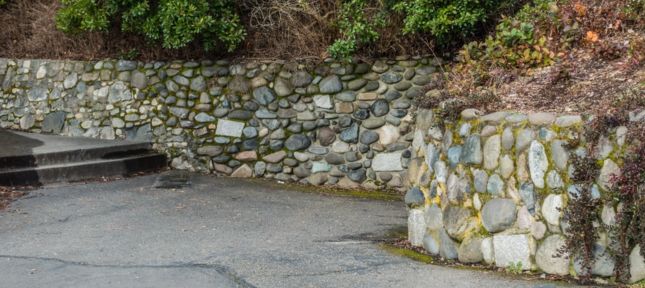
For instance, retaining walls can be used to divide a steep slope into multiple flatter sections, or terraces. This can improve slope stability and can provide property owners with more usable outdoor space. As you can see in the photograph below, the property features multiple retaining walls, and these protect the driveway as well as adding interest and curb appeal.

Retaining walls are an excellent addition to any yard or property where there are significant elevation changes. These walls, when combined with adequate drainage, improve stability, prevent erosion, and help protect adjacent structures. Of course, once again, if you are installing any type of retaining wall, proper waterproofing will keep this structure safe for years to come.
Need Waterproofing? Contact Thome Today!
At Thome Waterproofing, our team of waterproofing contractors provides a wide range of services. In addition to retaining wall waterproofing, we can provide you with planter waterproofing, balcony waterproofing, deck waterproofing, and deck coating, including pool deck coating. We also can provide any type of foundation waterproofing you might need.
Our waterproofing company serves residential and commercial clients throughout Los Angeles and Ventura counties. Whether you need retaining wall waterproofing or another of our services, contact us today to schedule a consultation and free cost estimate.
Comments are closed.